Declining Powers

I used to write these things like Post-it notes,
offhanded, effortless, with perfect rhyme
and subtle references to obscure quotes
that link to lives lived out in other times

when we wore other bodies, other names.
when nothing of us was as now we seem
and yet we loved each other just the same
while passing life to life as dream to dream.

I once could catch those days in words as sweet
and vivid as the days and nights were long
I sat at crossroads where the ages meet,
saw other times and wove them into song.

I wish I had the power still to do
as well, the poems I do for love of you.

©WILLIAM JOHN WATKINS

Post-concussion Syndrome a Year Later

It’s like I picked up the wrong head at the hat check window
and suddenly I’m the medium who can’t see ghosts any more.
I used to think in fractals, now it’s whole numbers, like everybody else.
You’d think as compensation, my common sense would have increased
but I’m computer dumb. Give me a set of directions and I can follow them,
unless you’ve left out a step, in which case I lock up
and give you the Windows Blue Screen of Death,
or if you leave me a choice or alternate steps, I will go back and forth
until time runs out and then pick one at random
and make up some implausible rationalization about why I picked it
in words that come like ketchup from an all but empty bottle.

It’s all in black & white  and blurred around the edges like a TV flashback
or an old horror movie complete with fog between you and the monster,
you’re always map-less and lost, the compass spinning,
always that vague sense that something is very wrong but you can’t tell what
just like it is when you’re bad stoned and don’t remember getting that way,
and you tell yourself the whole thing might be real interesting if just you went with it,
but you know you’re lying, it’s Nightmare City and you’re only in the suburbs.
Everything is oddly askew, and the color is off, and you stumble into things
like in the hour immediately after impact, when you don’t even know
you’ve been repeating the same three phrases for an hour straight.
And when it goes back to some semblance of the old reality,
you could almost laugh at the irony of it
if it wasn’t permanent.
©WILLIAM JOHN WATKINS

The Effect of Concussion on the Aging Brain

When I was first lost, Hippocrates appeared,
with maps of the canyons and the masses between,
like a ball of grey worms and black snakes,
or an old dried cheese, dropped, and fractured like spidering glass,
saying, “Here is the chasm where the words swung across on vines,
shredded now, on their way toward dazzling speech.
Now they must go a longer way round. Many will not make it,
and those that do come will come straggling.
What once came in floods will trickle in. You will wait in vain for the old fluency.

Here is the blockhouse of your organization,
that let you do two things at once better than most could do one;
the wires running out from it are broken at random, victims of torque.
Nothing now goes in a straight line for long.

Here is where the seminal promontory,
from which you could see everything from nine different perspectives,
collapsed into the canyon, taking the ability to make startling interconnections,
the root of all creativity, with it.  The broken wires dangle down the canyon wall.
Only an act of will now can stop you thinking like a bureaucrat.

Here are the outages in your sense of mission, where the great conduits broke
and your ability to focus ran out into the gorge. Smaller more circuitous routes
are being established. It will take time, and more energy than before.
As you can see, scattered everywhere, obstacles abound,
trees are down, roads blocked, highways dead-ended, old landmarks erased.
No matter what path you take, everything will take longer now.
Everything will be harder. Travel is difficult but not impossible.
Whatever route you take, you will never get all the way back.”

When I was first lost, I thought I was in a park.
When I looked at his maps, I saw that the park was in a wood,
with unused paths, and new ones needing to be cut.
When I started to cut them, I found that the woods was in a forest,
full of old growth and plenty of space between the trees, but no paths.
Until one day I came to a rise and I saw that the forest
was in a wilderness and the wilderness went on and on and on
in every direction.
©WILLIAM JOHN WATKINS

Standing Open-Mouthed Before the Department Realizing What Having Alzheimers Really Means

This mouth from which Demosthenes and Lenny Bruce
once jumped with equal frequency hangs open now,
a sagging factory door hung from a rusted hinge.
Inside, the floor is marred by stumps of broken bolts
that mark the grease streaked corners of machinery scars,
where something too big to be moved has been removed
nevertheless by some means Science cannot guess,
and dangling fixtures, wires that do not connect
hang in tangles and infrequent showers of sparks.
Thought slick as oiled silk’s rippling sheen was milled here once,
rolled out that door in bolts as big as forest logs
to waiting markets, and consumers thrilled to touch
such tight woven cloth, no torch could scorch nor knife mar,
in intricate designs only satellites could see.
How, between idea and the rising was the thread lost?
What silent bankruptcy sent midnight caravans
of moving vans to haul, silent as spent spiders,
that light-speed-flying-shuttle magic loom away?
How did the rust that clogs everything, even the air, silt in
unobserved for years, precipitate all at once?
What hoarfrost change of state made glass and water ice,
locked thought like lakes going over from freezing to frozen?
And what angstrom crevice  turning hairline crack split
so sudden into canyon deep forking fractures
of the unwordable, unfathomable,
but undeniable rupture’s realization.
©WILLIAM JOHN WATKINS

The Mad Professor Goes to Hear the Deans Explain the Budget

I like to go dressed up as death
when the faculty meets the king.
I like to put my death mask on
to hear the eunuchs sing.
I love to hear their budget lies,
they have such a musical ring.
I always wear my totenkopf
to hear the eunuchs sing.

I like to see them shake their heads,
(that’s not what’s been cut off)
I like to hear them wail and cry
in my rubberized totenkopf.

I love to hear them tell us why
our gold has turned to brass
then up I jump in my dead black robes
and tell’em to kiss my ass.

Their scandalized mouths make little pink O’s
when I swear before the king,
but I always appall
when I go to the hall
in my rubber death mask, black robes and all
to hear the eunuchs sing.
©WILLIAM JOHN WATKINS

The Mad Professor’s Vengeance

The Mad Professor has been reading Whitman again
and as always goes down to the boardwalk
to visit Roscoe the Uncommon Man,
who hates to be called “homeless” because
“This planet’s my home.
And if we don’t wise up to that,
the saucer people are going to take it away from us.”

Under La Maison Des Yuppies,
where cute is obligatory and food is a decoration,
Roscoe the Uncommon Man,
wearing a cologne made up of alcohol and shit
even the baptism of the sea cannot wash away,
lies like a piece of driftwood, oddly shaped,
grizzled with sea salt, flecked with tar,
in the crawl space the pilings make
between La Maison’s floor and the sand.

Afraid he will set himself on fire and burn it down,
the owners of La Maison
have sealed the space with heavy metal mesh.
But he pries, or digs under, unaware or uncaring
that the storm-driven tide comes in
all the way up in the wedge he lies down in.

At supper time, when the kitchen smells seep
down through the floor, The Mad Professor,
crouching to call under to inquire whether Roscoe is receiving,
finds the body hung in the wire
like a piece of newspaper crucified there by the wind.

Through the doors of La Maison,
the Mad Professor storms in like Jesus
to scatter the moneychangers;
he grabs the first tablecloth and yanks,
and because irony is the engine of the world,
it snaps flawlessly from under the glasses filled with Chardonnay
without spilling a drop,
and the plates rattle but sit at last
undisturbed as the New World Order,
and the couple who will be clean forever
in their celebrity-labeled clothes
begin a scattering of appreciative applause,
and hand him a tip.
©WILLIAM JOHN WATKINS

Kevin Hayter Shows Picasso at The Lincroft Inn

For my wife, Sandra (1942-2013)

We hung Picasso’s sketch up on the wall
we hung it on a coat hook, all we had
for temporary hanging, and although we knew
our lifetime’s wages couldn’t buy the like.
we hung it like some paint by number trash
or the scrawl of someone’s child, framed for a joke,
or out of overblown parental pride.
You might have thought
it was a yard sale purchase someone hung,
to show their shopping acumen or get a price
a little better than the one they paid.

A half a dozen fat and naked men,
some fallen down, and some about to fall,
all drunk on wine or on despair;
what might have been a fire on a beach
in some place where drunk men stand up and dance
when suicide’s no option, or when loss
makes going backward just as good as going on.
I thought how much you loved Picasso and I took
a photo with my phone in wretched light
hoping enough of it might show to bring
that smile Picasso even couldn’t paint,
forgetting in my haste you’d never see
another picture that I took for you.
Not then, not ever in this world.
And then I knew
why Picasso drew the way he drew
those sad men dancing and they way they danced.

©WILLIAM JOHN WATKINS

Fool to the King of Humanities

For years I have been the Fool
to the King of Humanities,
court jester to the crown
that clamps to your head like a vice
and cannot be taken off
until someone can be found
who will put it on instead,
in spite of the permanent crease
it will put around their skull,
in spite of the blood
that runs down from the band like sweat
and has to be wiped continually from the eyes,
someone idealistic and gullible as you were
when you first picked it up.

For years, I have been the Fool
to the King of Humanities,
since Carl the Commoner first picked up the Crown,
years ago, despite my warning,
‘It’s a curse, not a crown!
Put it down!
Put it down!”
But the good,
and the gullible,
who still believe that good can be done,
never listen to Fools
who no longer believe.

So for years I have watched
King Carl the Brave
defend the realm against armed idiots,
petty empire builders who climbed to the top
on a ladder of daggers
back by back,
fools for power
who would gallop an army off a cliff
as long as they got to lead.
And if there is peace now,
it is only because
so many of them were led
by his clever stratagems
to cliffs they could jump from.

For years I have watched
King Carl the Wise
divide a shrinking cake,
three times smaller than Necessity to begin with,
between people with common sense
and people with advanced degrees, all shouting
“Her piece is bigger than mine!”
and “He got all the icing!”
for the citizens of the Kingdom of Humanities
are an unruly lot
and the fact
that they did not fall to eating one another
during his reign
is not the least of his triumphs.

For years I have watched
King Carl the Diplomat
charm dragons and the parents of dragons
I would have killed gladly
and stuffed under the desk,
(What a surprise they’ll get
when they move that piece of furniture
out of Fort Literature.)
because it is easier to fight creatures
who don’t know what they want,
except a fight,
than to negotiate with them
and yet he would negotiate anyway,
even when they wanted to eat a faculty member,
saying, “Oh no. Not him. Not her.
They’re bad for your stomach.
They’re too tough to chew.
They’d only make you sick.”
until they went away grateful,
grinning from ear to ear,
that he had stopped them just in time
from biting into a turd sandwich.

Now the years are done
and the curse expiated,
and someone as fearless and good
has been gulled into taking the Crown,
I can pass on my cap and bells
to the next Fool,
and since every wife
already has a Fool of her own,
he knows who he is,
and King Carl of Humanities can become
Carl the Commoner again
selling songs in the street
to crowds of the deaf,
like the rest of us.

And all that remains to be said to Queen Sandy,
now, as the Crown of Humanities
clamps to her head like a vice
and cannot be given back
or taken off
for years and years
is
“The King is Free!
God Save the Queen.”
©WILLIAM JOHN WATKINS

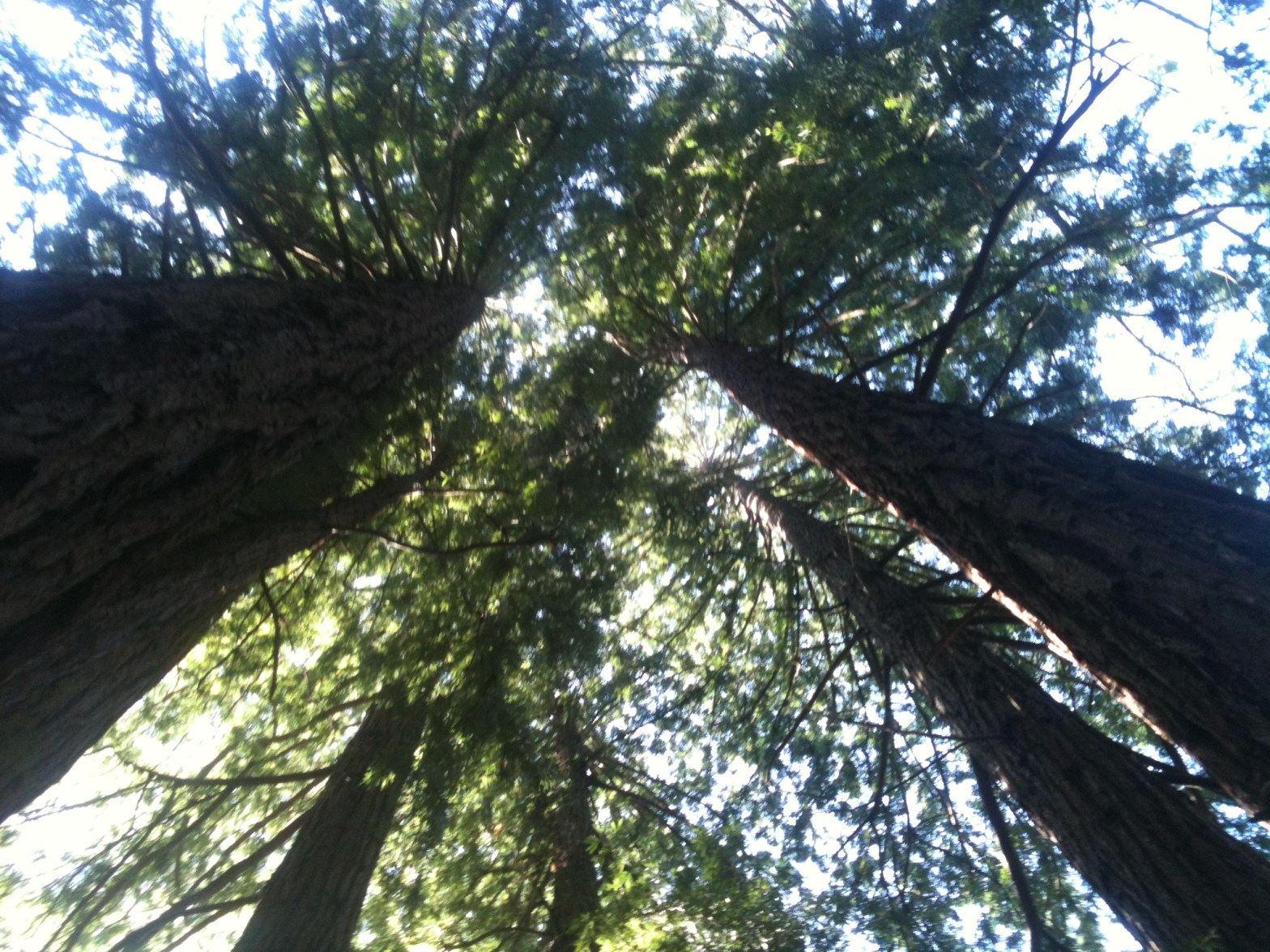
Light Shafts in the Campus Woods

All trees grow up the light,
sun shapes their list or slant
sun shapes their cast or cant
and twists them left or right

or turns them back again.
Sun shifts and they pursue
sun shifts and twist turns through
the dance light does and then

light lifts them up the air.
Suns shafts like trellis wire
sun shafts like angel fire
coax, prod, and twist them where

light draws them up its string.
Sun sifts and spreads them wide
sun sifts, they turn aside
to where the brightest brings

the growing tip that yearns.
Sun swirls, they stretch or squat
sun swirls, the tree branch knots
their lust for brightness burns.

In every twist it’s clear
that light went dancing here.
Who can deny the Good
slow shaped this dancing wood?
©WILLIAM JOHN WATKINS

Revolution

Rain leaps in the street like white flames.
Drops burst from macadam crevices like silver mortars.
A leaf goes by
running the streetwater;
only one,
with his autumn death already brown upon him.

One leaf, riding the streetwater,
this one time swept along by events.
One small leaf
still wondering why, when the wind whispered, he leaped.

One insignificant leaf whirled along in a revolution of water,
tearing itself on the macadam when the water almost runs out.
Almost
almost
almost
stopped,
time upon time
turning on one point
after another,
tip and stem
and needlepoint,
into the main current.

One revolutionary leaf
moving mindlessly unaware of his movement
in the inevitable current.

One other leaf,
aground,
immune to the water’s rush,
wearing her shroud of orange like a veil,
wondering why, when the wind whispered, she leapt  —
until
some wind
(why does it always happen just this way?)
ripples the center flow an inch, and they collide.

Hung on the honeyed moment they enjoy
the battle of go and stay
until they twist without breaking
into the sweep of water
to rush
to rush
to rush
headlong

under the parked machine.

And the water bubbles moon domes
like lives beginning
and loves flowering
and both bursting.
And the needles of rain leap out of the water in protest
and fall back invisible.

While brown and grey and grey/black, the water pours
out of the driveway and into the street,
into the street and under the car.

Leafless —
until one magnificent leaf
gold in his autumn death,
wearing his orange like a cloak of kings,
one giant, palm-wide leaf,
one majestic leaf,
moves in the rich brown center current
as if the water moves by him.

The rain quickens like a drumbeat
and a white shadow of wind blows across
(why does it always happen just this way?)

until behind him the matted leaves,
pressed and dead,
quicken as the swollen stream
reaches out like history
to touch them.

And they too spin and wheel
and free themselves of rises where the last rain left them
to rush together like a nation of madmen
headlong after the majestic leaf
down the rich brown center current of time
headlong
headlong
headlong

into death.

(why does it always happen just this way?)

©WILLIAM JOHN WATKINS (1969)